Apply Electricity concepts through 43 original questions covering MCQs, assertion–reason, short answers, long answers and case studies. Attempt each question before opening its answer and worked solution.
Electric current and chargePotential difference and metersResistance and resistivityCombination of resistorsHeating effect and electric powerHousehold circuits and safety
At a point in a wire, current is 0.80 A. Approximately how many electrons pass per second?
(A) 5×10¹⁷ (B) 5×10¹⁸ (C) 8×10¹⁸ (D) 1.28×10²⁰
Show answer and solution
Answer: (B) 5×10¹⁸
Worked solution: Current I=Q/t. The number of electrons per second is n=I/e=0.80/(1.6×10−19)=5×1018. Hence option (B) is correct.
Question 2 · MCQ · Apply · 1 mark
Charge and electrons
Electric current and charge
A charge of 3.2 C passes through a wire in 8 s. The number of electrons is:
(A) 2×10¹⁸ (B) 2×10¹⁹ (C) 5×10¹⁹ (D) 1.6×10²⁰
Show answer and solution
Answer: (B) 2×10¹⁹
Worked solution: Use n=Q/e. Thus n=3.2/(1.6×10−19)=2×1019 electrons. Hence option (B) is correct.
Question 3 · MCQ · Understand · 1 mark
Electrical energy
Potential difference and meters
Which expression gives energy transferred to charge Q through potential difference V?
(A) V/Q (B) VQ (C) Q/V (D) Q/t
Show answer and solution
Answer: (B) VQ
Worked solution: Potential difference is V=W/Q. Therefore W=VQ. Hence option (B) is correct.
Question 4 · MCQ · Apply · 1 mark
Meter connections
Potential difference and meters
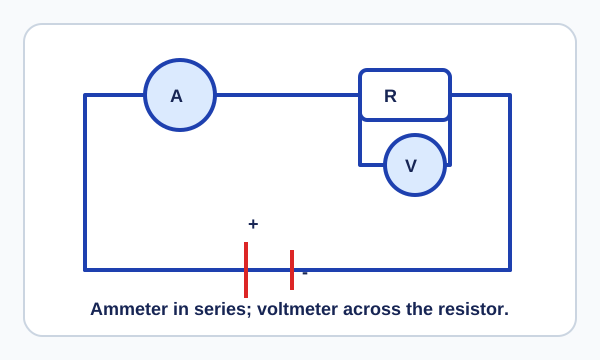
A student measures current through a lamp and voltage across it. Which connection is correct?
(A) Both meters in series (B) Ammeter parallel, voltmeter series (C) Ammeter series, voltmeter parallel (D) Both parallel
Ammeter in series and voltmeter across the resistor.Show answer and solution
Answer: (C) Ammeter series, voltmeter parallel
Worked solution: An ammeter measures current through the component, so it is in series. A voltmeter compares the two terminals of the lamp, so it is in parallel. Hence option (C) is correct.
Question 5 · MCQ · Apply · 1 mark
Voltmeter position
Potential difference and meters
A 6 V cell drives a 3Ω resistor. Where should the voltmeter be connected?
(A) Across the resistor (B) In series ahead of the cell (C) In place of the resistor (D) Only across the ammeter
Show answer and solution
Answer: (A) Across the resistor
Worked solution: A voltmeter must be connected across the component whose potential difference is required. Hence option (A) is correct.
Question 6 · MCQ · Analyse · 1 mark
I-V graph slope
Resistance and resistivity
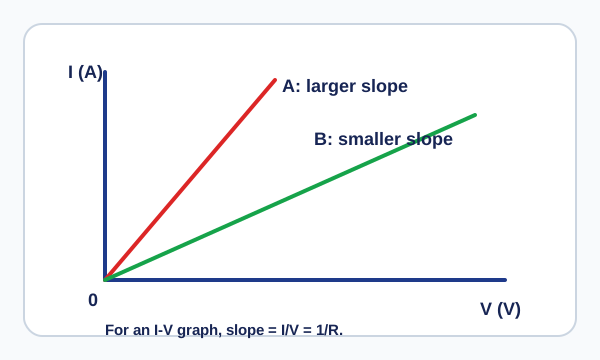
On an I versus V plot, line A has slope 0.5 A/V and line B has slope 0.25 A/V. Which resistance is larger?
(A) A is twice B (B) B is twice A (C) They are equal (D) Cannot be determined
The steeper I-V line has lower resistance.Show answer and solution
Answer: (B) B is twice A
Worked solution: For an I-versus-V graph, slope I/V=1/R. Thus RA=2Ω and RB=4Ω. B has twice the resistance of A.
Question 7 · MCQ · Apply · 1 mark
Wire diameter and resistance
Resistance and resistivity
A wire of given material and length is replaced by one with twice the diameter. Its new resistance is:
(A) R/4 (B) R/2 (C) 2R (D) 4R
Show answer and solution
Answer: (A) R/4
Worked solution: Area is proportional to diameter squared. Doubling diameter makes area 4A, while R=ρL/A. Therefore the new resistance is R/4.
Question 8 · MCQ · Apply · 1 mark
Equal resistance wires
Resistance and resistivity
Wire B is three times as long as wire A but has the same resistance and material. What is AB:AA?
(A) 1:3 (B) 1:1 (C) 3:1 (D) 9:1
Show answer and solution
Answer: (C) 3:1
Worked solution: Since R=ρL/A, keeping R same while length becomes 3L requires area 3A. Hence AB:AA=3:1.
Question 9 · MCQ · Analyse · 1 mark
Least resistance
Resistance and resistivity
For equal-material wires, which has the least resistance?
(A) Length L, diameter d (B) Length L, diameter 2d (C) Length 2L, diameter 2d (D) Length L/2, diameter d
Show answer and solution
Answer: (B) Length L, diameter 2d
Worked solution: Resistance varies as L/d2. The relative values are 1, 1/4, 1/2, and 1/2. Option (B) is least.
Question 10 · MCQ · Apply · 1 mark
Cross-sectional area
Resistance and resistivity
Wire B has length 4L and resistance 2R compared with wire A of length L, resistance R and area A. Its cross-section is:
(A) A/2 (B) A (C) 2A (D) 4A
Show answer and solution
Answer: (C) 2A
Worked solution: 2R=ρ(4L)/AB while R=ρL/A. Comparing gives AB=2A. Hence option (C) is correct.
Question 11 · MCQ · Understand · 1 mark
Temperature effect
Resistance and resistivity
At approximately constant geometry, a metallic wire is heated. Its resistance generally:
(A) Falls (B) Rises (C) Becomes zero (D) Must remain identical
Show answer and solution
Answer: (B) Rises
Worked solution: Metals generally have a positive temperature coefficient of resistance. Hence option (B) is correct.
Question 12 · MCQ · Understand · 1 mark
Resistivity as a material property
Resistance and resistivity
At fixed material and temperature, a wire length doubles. What happens to resistivity ρ?
Worked solution: Resistivity is a material property at a fixed temperature. Resistance changes with length, but ρ does not. Hence option (D) is correct.
Question 13 · MCQ · Apply · 1 mark
Series current
Combination of resistors
A 4Ω lamp and a 6Ω resistor are in series. Current through the resistor is 0.30 A. Current through the lamp is:
(A) 0.18 A (B) 0.30 A (C) 0.50 A (D) 0.75 A
Show answer and solution
Answer: (B) 0.30 A
Worked solution: There is one unbranched series path, so the same current flows through each component. Hence option (B) is correct.
Question 14 · MCQ · Apply · 1 mark
Maximum equivalent resistance
Combination of resistors
Five separate 2Ω resistors must all be used. What is the largest achievable equivalent resistance?
(A) 0.4Ω (B) 2Ω (C) 5Ω (D) 10Ω
Show answer and solution
Answer: (D) 10Ω
Worked solution: The largest equivalent resistance is obtained in series: 5×2=10Ω.
Question 15 · MCQ · Apply · 1 mark
Parallel branches
Combination of resistors
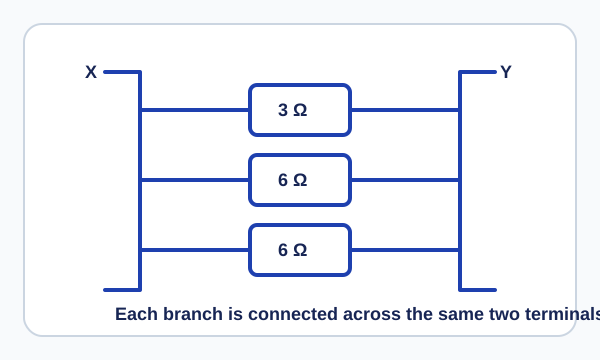
Three branches of 3Ω, 6Ω, and 6Ω connect the same terminals X and Y. Their equivalent resistance is:
(A) 1.5Ω (B) 2Ω (C) 3Ω (D) 15Ω
Each branch has the same terminal potential difference.Show answer and solution
Answer: (A) 1.5Ω
Worked solution: 1/R=1/3+1/6+1/6=2/3. Therefore R=1.5Ω. Hence option (A) is correct.
Question 16 · MCQ · Apply · 1 mark
Four resistors in series
Combination of resistors
What is the maximum equivalent resistance using four 3Ω resistors, all included?
(A) 3/4Ω (B) 3Ω (C) 9Ω (D) 12Ω
Show answer and solution
Answer: (D) 12Ω
Worked solution: Connect all four resistors in series: 3+3+3+3=12Ω.
Question 17 · MCQ · Apply · 1 mark
Series-parallel ratio
Combination of resistors
Four 3Ω resistors give Rs in series and Rp in parallel. What is Rs:Rp?
(A) 4:1 (B) 8:1 (C) 16:1 (D) 1:16
Show answer and solution
Answer: (C) 16:1
Worked solution: Rs=12Ω and Rp=3/4Ω. Thus Rs:Rp=12:(3/4)=16:1.
Question 18 · MCQ · Apply · 1 mark
Cells in series
Potential difference and meters
Three identical 1.5 V cells are connected in series aiding. Their net emf is:
(A) 1.5 V (B) 3.0 V (C) 4.5 V (D) 0 V
Show answer and solution
Answer: (C) 4.5 V
Worked solution: In series aiding, emfs add: 1.5+1.5+1.5=4.5 V. Hence option (C) is correct.
Question 19 · MCQ · Apply · 1 mark
Heating at fixed voltage
Heating effect and electric power
An ideal fixed-voltage supply feeds a resistor. If its resistance becomes 3R while time stays t, the new heat compared with initial heat H is:
(A) H/3 (B) H (C) 3H (D) 9H
Show answer and solution
Answer: (A) H/3
Worked solution: For fixed voltage and time, H=V2t/R. Replacing R by 3R gives H/3.
Question 20 · MCQ · Apply · 1 mark
Heat in a series resistor
Heating effect and electric power
A 3Ω and 9Ω resistor are in series across 12 V for 4 s. Heat in the 9Ω resistor is:
(A) 9 J (B) 18 J (C) 36 J (D) 48 J
Show answer and solution
Answer: (C) 36 J
Worked solution: Total resistance is 12Ω, so I=1 A. Heat in 9Ω is I2Rt=12×9×4=36 J.
Question 21 · MCQ · Analyse · 1 mark
Greatest energy draw
Combination of resistors
Across the same 12 V supply for equal time, which draws the most electrical energy?
(A) One 4Ω resistor (B) Two 4Ω resistors in series (C) Two 4Ω resistors in parallel (D) All are equal
Show answer and solution
Answer: (C) Two 4Ω resistors in parallel
Worked solution: Equivalent resistances are 4Ω, 8Ω, and 2Ω. Since W=V2t/R, the smallest resistance draws the most energy.
Question 22 · MCQ · Apply · 1 mark
Voltage from power
Heating effect and electric power
A 5Ω resistor converts 45 J to heat in 1 s. Voltage across it is:
(A) 5 V (B) 10 V (C) 15 V (D) 25 V
Show answer and solution
Answer: (C) 15 V
Worked solution: Power is 45 W. Using P=V2/R, 45=V2/5, so V2=225 and V=15 V.
Question 23 · MCQ · Apply · 1 mark
Fuse rating
Household circuits and safety
A 900 W device operates at 230 V. Among idealised ratings 2 A, 4 A, 6 A and 10 A, choose the smallest rating above normal current.
(A) 2 A (B) 4 A (C) 6 A (D) 10 A
Show answer and solution
Answer: (B) 4 A
Worked solution: Normal current is I=P/V=900/230≈3.91 A. The smallest listed rating above this is 4 A.
Question 24 · MCQ · Understand · 1 mark
High-power appliance current
Household circuits and safety
At the same household voltage, which appliance draws greater current?
(A) 150 W fan (B) 1200 W heater (C) Both equal (D) Impossible to tell
Show answer and solution
Answer: (B) 1200 W heater
Worked solution: At fixed voltage, I=P/V. The higher rated power draws greater current. Hence option (B) is correct.
Question 25 · MCQ · Apply · 1 mark
Power change with current
Heating effect and electric power
Through a fixed resistor, current becomes 3I. What is the percentage increase in power?
(A) 200% (B) 300% (C) 800% (D) 900%
Show answer and solution
Answer: (C) 800%
Worked solution: P2=(3I)2R=9P1. The increase is 8P1, which is 800%.
Question 26 · A-R · Apply · 1 mark
Length and resistance
Resistance and resistivity
Assertion (A): At constant cross-section, material and temperature, tripling a wire's length triples its resistance. Reason (R): R=ρL/A.
(a) Both A and R are true, and R correctly explains A. (b) Both A and R are true, but R does not explain A. (c) A is true, but R is false. (d) A is false, but R is true.
Show answer and solution
Answer: (A) Both A and R are true, and R correctly explains A.
Worked solution: With all other factors fixed, R is directly proportional to L. The stated formula directly explains the assertion.
Question 27 · A-R · Analyse · 1 mark
Copper lead heat loss
Heating effect and electric power
Assertion (A): A copper lead typically wastes less energy than an identical high-resistivity alloy lead carrying the same current. Reason (R): For fixed current and time, H=I2Rt.
(a) Both A and R are true, and R correctly explains A. (b) Both A and R are true, but R does not explain A. (c) A is true, but R is false. (d) A is false, but R is true.
Show answer and solution
Answer: (A) Both A and R are true, and R correctly explains A.
Worked solution: Copper has lower resistance for the same dimensions. At fixed current and time, lower R produces lower heat loss by H=I2Rt.
Question 28 · A-R · Analyse · 1 mark
Temperature and short circuit
Household circuits and safety
Assertion (A): Every increase in a wire's temperature necessarily causes a short circuit. Reason (R): A metal wire's resistance generally increases with temperature.
(a) Both A and R are true, and R correctly explains A. (b) Both A and R are true, but R does not explain A. (c) A is true, but R is false. (d) A is false, but R is true.
Show answer and solution
Answer: (D) A is false, but R is true.
Worked solution: A short circuit is an unintended low-resistance path. Heating a metal wire does not itself create that path, although its resistance generally increases.
Question 29 · A-R · Understand · 1 mark
Nichrome heating elements
Heating effect and electric power
Assertion (A): Nichrome can be suitable for a heating element. Reason (R): It has relatively high resistivity, a high melting point and tolerates high operating temperature.
(a) Both A and R are true, and R correctly explains A. (b) Both A and R are true, but R does not explain A. (c) A is true, but R is false. (d) A is false, but R is true.
Show answer and solution
Answer: (A) Both A and R are true, and R correctly explains A.
Worked solution: Nichrome's high resistivity helps generate heat and its high melting point helps it withstand the temperature. The reason explains the assertion.
Question 30 · A-R · Understand · 1 mark
Heating element survival
Heating effect and electric power
Assertion (A): A heating element should withstand the temperature reached during operation. Reason (R): A material with a suitable high melting point can remain intact when heated strongly.
(a) Both A and R are true, and R correctly explains A. (b) Both A and R are true, but R does not explain A. (c) A is true, but R is false. (d) A is false, but R is true.
Show answer and solution
Answer: (A) Both A and R are true, and R correctly explains A.
Worked solution: An element must not melt during use. A suitable high melting point directly supports this requirement.
Question 31 · A-R · Apply · 1 mark
Bulb rating comparison
Heating effect and electric power
Assertion (A): A 60 W and a 100 W incandescent bulb connected in parallel across their common rated voltage: the 100 W bulb consumes more power. Reason (R): Their rated powers at that voltage are 100 W and 60 W respectively.
(a) Both A and R are true, and R correctly explains A. (b) Both A and R are true, but R does not explain A. (c) A is true, but R is false. (d) A is false, but R is true.
Show answer and solution
Answer: (A) Both A and R are true, and R correctly explains A.
Worked solution: In parallel each bulb receives its rated voltage. Their stated ratings therefore show that the 100 W bulb consumes more power.
Question 32 · A-R · Apply · 1 mark
Measured V and I
Potential difference and meters
Assertion (A): Measuring V across and I through an ohmic resistor permits calculation of its resistance and power. Reason (R): For this resistor, R=V/I and P=VI.
(a) Both A and R are true, and R correctly explains A. (b) Both A and R are true, but R does not explain A. (c) A is true, but R is false. (d) A is false, but R is true.
Show answer and solution
Answer: (A) Both A and R are true, and R correctly explains A.
Worked solution: The formulas use the simultaneously measured potential difference and current. The reason directly explains the assertion.
Question 33 · Case Study · Apply · 5 marks
Workstation circuit
Combination of resistors
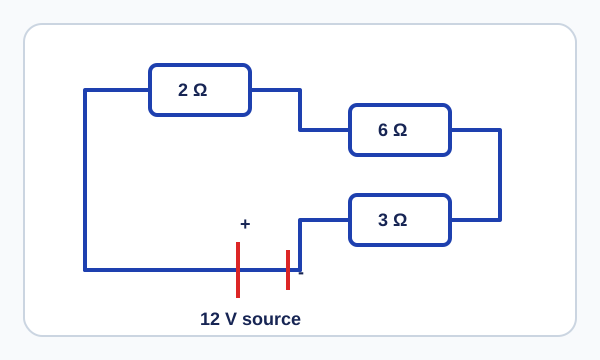
A 12 V workstation supply feeds a 2Ω resistor in series with a parallel pair of 6Ω and 3Ω. Take the battery as ideal.
Answer the following: (i) Find the parallel-pair resistance. [1 mark] (ii) Find total resistance and source current. [1 mark] (iii) Find the potential difference across the parallel pair. [1 mark] (iv) Find currents through the 6Ω and 3Ω branches. [1 mark] (v) If the 6Ω branch is disconnected, find the new total current. [1 mark]
A 2 ohm series resistor is followed by 6 ohm and 3 ohm parallel branches.Show answer and solution
Answer: (i) 2Ω; (ii) 4Ω, 3 A; (iii) 6 V; (iv) 1 A and 2 A; (v) 2.4 A.
Worked solution: (i) 1/Rp=1/6+1/3=1/2, so Rp=2Ω. (ii) Rtotal=2+2=4Ω, so I=12/4=3 A. (iii) The series 2Ω drops IR=6 V, so the parallel pair has 6 V. (iv) I6=6/6=1 A and I3=6/3=2 A. (v) With only 3Ω branch, total resistance is 2+3=5Ω, so current is 12/5=2.4 A.
Question 34 · Case Study · Analyse · 5 marks
Testing a solar lamp
Resistance and resistivity
An ohmic lamp test at nearly constant temperature gives (V,I) readings (2 V,0.1 A), (4 V,0.2 A), and (6 V,0.3 A). Treat the device as ohmic in this narrow range.
Answer the following: (i) Find its resistance. [1 mark] (ii) For an I-on-vertical versus V-on-horizontal graph, find the slope. [1 mark] (iii) If V becomes 8 V at constant resistance, find current. [1 mark] (iv) At 6 V, find power. [1 mark] (v) If both V and R double, what happens to current? [1 mark]
An ohmic I-V graph has constant slope.Show answer and solution
Answer: (i) 20Ω; (ii) 0.05 A/V; (iii) 0.4 A; (iv) 1.8 W; (v) Current stays unchanged.
Worked solution: (i) R=V/I=2/0.1=20Ω. (ii) Slope ΔI/ΔV=0.1/2=0.05 A/V, which is 1/R. (iii) I=8/20=0.4 A. (iv) P=VI=6×0.3=1.8 W. (v) I′=2V/(2R)=V/R, so it remains the same.
Question 35 · VSA · Apply · 2 marks
Charge transferred
Electric current and charge
A 0.5 A current flows for 30 s. Find the charge transferred.
Show answer and solution
Answer: 15 C
Worked solution: Use Q=It=0.5×30=15 C.
Question 36 · VSA · Understand · 2 marks
Unit of resistivity
Resistance and resistivity
Give the SI unit of resistivity.
Show answer and solution
Answer: Ω m
Worked solution: From R=ρL/A, we get ρ=RA/L. Its SI unit is ohm metre, written Ω m.
Question 37 · VSA · Understand · 2 marks
Current relation in series
Combination of resistors
In a series circuit, two lamps carry currents I1 and I2. State their relation.
Show answer and solution
Answer: I1=I2
Worked solution: A series circuit has one unbranched path, so the same current passes through every component.
Question 38 · SA · Apply · 3 marks
Measuring resistance
Potential difference and meters
Describe how to measure the resistance of a 5Ω resistor using a DC supply, ammeter and voltmeter. With readings V=10 V and I=2 A, verify the resistance.
Standard ammeter-voltmeter arrangement.Show answer and solution
Answer: Connect the ammeter in series and the voltmeter across the resistor. The resistance is 5Ω.
Worked solution: Place the ammeter in series with the resistor and the voltmeter across it. Connect positive meter terminals toward the positive side of the cell, close the switch and read both meters. R=V/I=10/2=5Ω.
Question 39 · SA · Apply · 3 marks
Stretched wire
Resistance and resistivity
A wire of resistance 8Ω is stretched to twice its length while volume stays constant. Find new resistance, assuming unchanged resistivity and temperature.
Show answer and solution
Answer: 32Ω
Worked solution: Constant volume gives AL=A′L′, so when length doubles, area becomes A/2. Thus R′=ρ(2L)/(A/2)=4R=32Ω.
Question 40 · SA · Apply · 3 marks
Power and heat
Heating effect and electric power
A 10Ω resistor receives 20 V for 30 s. Find current, power and heat produced.
Show answer and solution
Answer: Current 2 A; power 40 W; heat 1200 J.
Worked solution: I=V/R=20/10=2 A. P=VI=20×2=40 W. Heat H=Pt=40×30=1200 J.
Question 41 · LA · Apply · 5 marks
Series-parallel supply
Combination of resistors
A 24 V ideal source is connected to a 4Ω resistor in series with a parallel pair of 12Ω and 6Ω. Calculate (i) total resistance, (ii) source current, (iii) branch currents, (iv) total power and (v) verify that branch currents add correctly.
Show answer and solution
Answer: Rtotal=8Ω; source current 3 A; branch currents 1 A and 2 A; total power 72 W.
Worked solution: 1/Rp=1/12+1/6=3/12, so Rp=4Ω and Rtotal=8Ω. Source current is 24/8=3 A. The series 4Ω drops 12 V, so branch currents are 12/12=1 A and 12/6=2 A. Total power is VI=24×3=72 W. Finally, 1+2=3 A, matching source current.
Question 42 · LA · Analyse · 5 marks
Changing an element
Heating effect and electric power
A device contains a 6Ω element on a fixed 12 V supply for 5 minutes. It is replaced with a 12Ω element while voltage and duration remain fixed. Calculate original and new current, power and electrical energy; state the energy ratio.
Show answer and solution
Answer: Original: 2 A, 24 W, 7200 J. New: 1 A, 12 W, 3600 J. Energy ratio 1:2.
Worked solution: Time is 300 s. Initially I1=12/6=2 A, P1=122/6=24 W and E1=24×300=7200 J. With 12Ω, I2=1 A, P2=122/12=12 W and E2=12×300=3600 J. Thus E2/E1=1/2.
Question 43 · LA · Analyse · 5 marks
Comparing two conductors
Resistance and resistivity
Two ohmic conductors give points on an I-versus-V graph: conductor A (3 V,0.30 A) and conductor B (3 V,0.15 A). (i) Calculate both resistances and slopes. (ii) At common 6 V, find currents and their ratio. (iii) Explain which graph is steeper.
Lower resistance gives a steeper I-V graph.Show answer and solution
Answer: RA=10Ω, RB=20Ω; slopes 0.10 A/V and 0.05 A/V; currents 0.60 A and 0.30 A, ratio 2:1; A is steeper.
Worked solution: RA=3/0.30=10Ω and RB=3/0.15=20Ω. Their I-V slopes are 0.10 A/V and 0.05 A/V. At 6 V, currents are 6/10=0.60 A and 6/20=0.30 A, giving ratio 2:1. A is steeper because I-V slope equals 1/R.