Class 10 Maths Standard Build chapter confidence with fresh questions before moving to exam-focused revision.
Why use practice questions?
Practice Questions help you learn and correct a topic through repeated attempts and explanations. Use Important Questions for priority revision, PYQs for past-board patterns, and Competency Questions for new application situations.
Notes, formulae and solved examples Practice coverage: 155 published questions across 6 formats.
Maths Science
Chapter All chapters Real Numbers Polynomials Pair of Linear Equations in Two Variables Quadratic Equations Arithmetic Progressions Coordinate Geometry Triangles Circles Introduction to Trigonometry Trigonometric Identities Heights and Distances Areas Related to Circles Surface Areas and Volumes Statistics Probability Topic All topics Fundamental Theorem of Arithmetic Irrational Numbers Zeroes of a Polynomial: Graphical Method Zeroes of a Polynomial: Algebraic Method Relationship Between Zeroes and Coefficients Graphical Method and Consistency Algebraic Conditions for Number of Solutions Substitution Method Elimination Method Situational Problems Standard Form Factorisation Method Quadratic Formula Nature of Roots Situational Problems Arithmetic Progression nth Term Sum of First n Terms Daily Life Problems Distance Formula Section Formula Similarity Criteria Basic Proportionality Theorem Converse of Basic Proportionality Theorem Pythagoras Theorem Tangent Perpendicular to Radius Tangents from an External Point Trigonometric Ratios of Acute Angles Ratios at 0 Degrees and 90 Degrees Standard Angle Values Relationships Between Trigonometric Ratios Proof and Applications of Trigonometric Identities Angle of Elevation Angle of Depression Area of Sector Area of Segment Perimeter and Circumference Problems Surface Areas of Combined Solids Volumes of Combined Solids Mean of Grouped Data: Direct Method Mean of Grouped Data: Assumed Mean and Step Deviation Median and Mode of Grouped Data Classical Definition of Probability Probability of an Event
MCQs A-R VSA SA LA Case Study
Base: Build concepts Focus: Apply with confidence
A. Greater than 0 B. Equal to 0 C. Less than 0 D. Cannot be found Select an option first. The solution will unlock after your attempt.
What is the discriminant of a quadratic equation?
For a x 2 + b x + c = 0 b 2 − 4 a c
When are the roots of a quadratic equation equal?
The roots are equal when the discriminant is exactly equal to 0.
A. First term B. Common difference C. Last term D. Mean term Select an option first. The solution will unlock after your attempt.
What is common difference in AP?
It is the fixed difference between any two consecutive terms of an arithmetic progression.
A. 6 B. 5 C. -5 D. -6 Select an option first. The solution will unlock after your attempt.
What is the sum of zeros of $ax^2 + bx + c$?
The sum of zeros is a − b
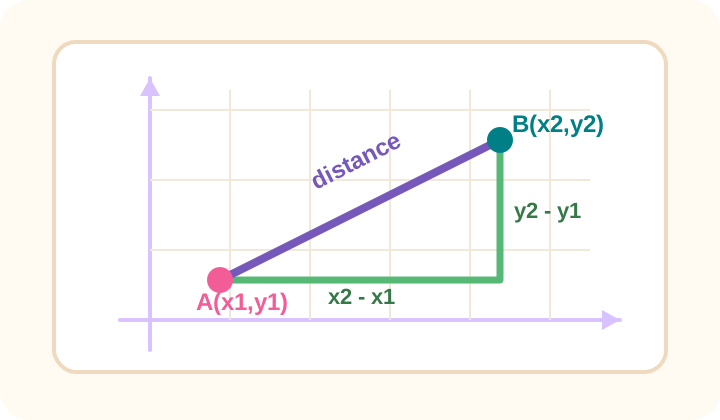
Coordinate geometry diagram for deriving the distance between two points. A. Only x 2 − x 1 B. Only y 2 − y 1 C. Pythagoras theorem D. Area of triangle Select an option first. The solution will unlock after your attempt.
Which theorem is used in the distance formula?
The distance formula is derived using Pythagoras theorem on a right triangle formed on the coordinate plane.
A. a = b q + r , 0 ≤ r < b B. b = a q + r , r > a C. a = b r , q = 0 D. a + b = q + r Select an option first. The solution will unlock after your attempt.
What is the condition on remainder in Euclid's division lemma?
The remainder r 0 ≤ r < b
A. H C F + L C M = ab B. H C F × L C M = ab C. H C F = L C M D. L C M − H C F = ab Select an option first. The solution will unlock after your attempt.
What is the HCF-LCM product relation?
For two numbers a b H C F × L C M = a × b
A. 2 2 × 3 2 × 5 B. 2 × 3 2 × 5 2 C. 2 3 × 3 × 5 D. 2 2 × 3 × 5 2 Select an option first. The solution will unlock after your attempt.
Why is prime factorisation useful?
It helps find HCF, LCM, and proves properties of numbers.
A. 49 B. 64 C. 2 D. 0.25 Select an option first. The solution will unlock after your attempt.
Is every square root irrational?
No. Square roots of perfect squares are rational.
A. Terminating B. Non-terminating repeating C. Non-terminating non-repeating D. Cannot be decided Select an option first. The solution will unlock after your attempt.
When does a rational number have terminating decimal expansion?
After simplification, denominator should be of the form 2 m 5 n
A. 1 B. 2 C. 3 D. 5 Select an option first. The solution will unlock after your attempt.
What is the degree of a polynomial?
It is the highest power of the variable with non-zero coefficient.
A. − 4 B. 0 C. 4 D. 1 Select an option first. The solution will unlock after your attempt.
What is a zero of a polynomial?
A zero is a value of x p ( x ) = 0
A. 2 7 B. 2 3 C. − 2 7 D. − 2 3 Select an option first. The solution will unlock after your attempt.
What is product of zeros of $ax^2+bx+c$?
The product of zeros is a c
A. Y-axis B. X-axis C. Origin only D. Both axes equally Select an option first. The solution will unlock after your attempt.
How are zeros seen on a graph?
Zeros are the X-coordinates of points where the graph cuts or touches the X-axis.
A. Lines are parallel B. Lines are coincident C. Lines intersect at one point D. Lines never meet Select an option first. The solution will unlock after your attempt.
What does unique solution mean graphically?
It means the two lines intersect at exactly one point.
A. One solution B. Two solutions C. No solution D. Infinitely many solutions Select an option first. The solution will unlock after your attempt.
When does a pair of linear equations have no solution?
When the two lines are parallel and distinct.
A. 4 B. 5 C. 8 D. 10 Select an option first. The solution will unlock after your attempt.
Why does elimination work here?
Adding the equations cancels y x
A. a 2 a 1 = b 2 b 1 B. a 2 a 1 = b 2 b 1 = c 2 c 1 C. a 2 a 1 = b 2 b 1 = c 2 c 1 D. a 1 = a 2 = 0 Select an option first. The solution will unlock after your attempt.
Which ratio condition gives parallel distinct lines?
a 2 a 1 = b 2 b 1 = c 2 c 1
A. a x + b = 0 B. a x 2 + b x + c = 0 , a = 0 C. a x 3 + b x + c = 0 D. x + y = 0 Select an option first. The solution will unlock after your attempt.
Why must $a\ne0$ in a quadratic equation?
If a = 0
A. 1 , 6 B. 2 , 3 C. − 2 , − 3 D. 5 , 6 Select an option first. The solution will unlock after your attempt.
How do we solve by factorisation?
Split the middle term and write the equation as product of two factors equal to zero.
A. Two distinct real roots B. Two equal real roots C. No real roots D. Only one root always Select an option first. The solution will unlock after your attempt.
What does positive discriminant mean?
It means two distinct real roots.
A. Two equal real roots B. Two distinct real roots C. No real roots D. One rational root Select an option first. The solution will unlock after your attempt.
When does a quadratic equation have no real roots?
When the discriminant b 2 − 4 a c 0
A. a n = a + ( n − 1 ) d B. a n = a + n d C. a n = a d n D. a n = n ( a + d ) Select an option first. The solution will unlock after your attempt.
Why is it $(n-1)d$ in AP nth term?
The first term has zero common differences added, so the n ( n − 1 )
A. S n = 2 n [ 2 a + ( n − 1 ) d ] B. S n = a + ( n − 1 ) d C. S n = n d D. S n = n a Select an option first. The solution will unlock after your attempt.
Which formula gives sum of first $n$ AP terms?
S n = 2 n [ 2 a + ( n − 1 ) d ]
A. 3 B. 4 C. 7 D. 11 Select an option first. The solution will unlock after your attempt.
How is common difference found?
Subtract any term from the next term: d = a 2 − a 1
A. 14 B. 15 C. 16 D. 17 Select an option first. The solution will unlock after your attempt.
How do we check position of a term in AP?
Put the term equal to a + ( n − 1 ) d n
A. SSS criterion B. SAS criterion C. AAA criterion D. RHS criterion Select an option first. The solution will unlock after your attempt.
Does AAA prove congruence?
No. AAA proves similarity, not necessarily congruence.
A. Equally always B. In the same ratio C. In inverse ratio only D. At right angles Select an option first. The solution will unlock after your attempt.
What does BPT state?
A line parallel to one side of a triangle divides the other two sides in the same ratio.
A. 10 B. 12 C. 14 D. 16 Select an option first. The solution will unlock after your attempt.
When can Pythagoras theorem be used?
It can be used only in a right triangle.
A. 2 : 3 B. 3 : 2 C. 4 : 9 D. 8 : 27 Select an option first. The solution will unlock after your attempt.
How are areas of similar triangles related?
Their areas are proportional to the squares of corresponding sides.
A. ( 4 , 6 ) B. ( 8 , 12 ) C. ( 2 , 6 ) D. ( 6 , 4 ) Select an option first. The solution will unlock after your attempt.
What is midpoint formula?
Midpoint is ( 2 x 1 + x 2 , 2 y 1 + y 2 )
A. ( 2 , 3 ) B. ( 3 , 2 ) C. ( 4 , 6 ) D. ( 6 , 9 ) Select an option first. The solution will unlock after your attempt.
What is internal section formula used for?
It finds a point dividing a line segment internally in a given ratio.
A. 6 B. 7 C. 12 D. 24 Select an option first. The solution will unlock after your attempt.
What is triangle area formula?
Area is 2 1 × ba se × h e i g h t
A. h y p o t e n u se o pp os i t e B. h y p o t e n u se a d j a ce n t C. a d j a ce n t o pp os i t e D. o pp os i t e h y p o t e n u se Select an option first. The solution will unlock after your attempt.
What is $\sin\theta$ in a right triangle?
sin θ = h y p o t e n u se o pp os i t e
A. sin 2 θ + cos 2 θ = 1 B. sin θ + cos θ = 1 C. tan θ = sin θ cos θ D. sec 2 θ + tan 2 θ = 1 Select an option first. The solution will unlock after your attempt.
What is the main trigonometric identity?
sin 2 θ + cos 2 θ = 1
A. 0 B. 2 1 C. 2 3 D. 1 Select an option first. The solution will unlock after your attempt.
What is $\sin30^\circ$?
sin 3 0 ∘ = 2 1
A. sin θ B. cos θ C. tan θ D. sec θ Select an option first. The solution will unlock after your attempt.
What is $\sin(90^\circ-\theta)$?
It equals cos θ
A. Vertical line upward B. Horizontal line upward C. Line of sight downward D. Ground perpendicular only Select an option first. The solution will unlock after your attempt.
What is angle of elevation?
It is the angle made with the horizontal when the observer looks upward.
A. 5 B. 10 C. 10 3 D. 20 Select an option first. The solution will unlock after your attempt.
Why is tangent used in height and shadow questions?
Because tangent connects opposite side and adjacent side: tan θ = s ha d o w h e i g h t
A. Centre B. Contact C. Diameter D. Chord midpoint always Select an option first. The solution will unlock after your attempt.
What is tangent-radius theorem?
A tangent is perpendicular to the radius at the point of contact.
A. Parallel B. Equal in length C. Always perpendicular to each other D. Unequal always Select an option first. The solution will unlock after your attempt.
What is true about tangents from an external point?
They are equal in length.
A. 36 0 ∘ θ π r 2 B. 2 π r C. π r 2 D. θ r 2 Select an option first. The solution will unlock after your attempt.
How is sector area calculated?
Sector area is 36 0 ∘ θ π r 2
A. 2 π r h B. π r 2 h C. 2 π r ( r + h ) D. 4 π r 2 Select an option first. The solution will unlock after your attempt.
What is curved surface area of cylinder?
It is 2 π r h
A. π r 2 h B. 3 1 π r 2 h C. 2 π r h D. 3 4 π r 3 Select an option first. The solution will unlock after your attempt.
What is volume of cone?
Volume of cone is 3 1 π r 2 h
A. 4 π r 2 B. 3 4 π r 3 C. π r 2 h D. 2 π r Select an option first. The solution will unlock after your attempt.
What is volume of sphere?
It is 3 4 π r 3
A. n u mb er o f o b ser v a t i o n s s u m o f o b ser v a t i o n s B. hi g h es t − l o w es t C. 2 hi g h es t + l o w es t D. f r e q u e n cy o n l y Select an option first. The solution will unlock after your attempt.
What is arithmetic mean?
Arithmetic mean is total of observations divided by number of observations.
A. Most frequent value B. Middle value after arranging data C. Average of all values D. Difference between highest and lowest Select an option first. The solution will unlock after your attempt.
What is median?
Median is the middle value of arranged data.
A. 3 B. 4 C. 5 D. 6 Select an option first. The solution will unlock after your attempt.
What is mode?
Mode is the observation with maximum frequency.
A. t o t a l o u t co m es f a v o u r ab l e o u t co m es B. f a v o u r ab l e + t o t a l C. t o t a l − f a v o u r ab l e D. f a v o u r ab l e t o t a l Select an option first. The solution will unlock after your attempt.
What is basic probability formula?
P ( E ) = t o t a l o u t co m es f a v o u r ab l e o u t co m es
A. 0 B. 2 1 C. 1 D. 2 Select an option first. The solution will unlock after your attempt.
What is probability of head in one coin toss?
It is 2 1
A. 6 1 B. 3 1 C. 2 1 D. 3 2 Select an option first. The solution will unlock after your attempt.
How many even outcomes are there on a die?
There are three even outcomes: 2 , 4 , 6