
Study Method
How to Use Formula-First Practice Without Memorising Blindly
Formula-first practice helps students understand when to use a formula, how it works, and how to apply it in exam-style questions without blind memorisation.
Table Of Contents
Formula First Means Understanding First
Remembering a formula is only the first step. The real challenge is knowing when to use it and how to apply it.
That is what formula-first practice is about. Instead of trying to memorise every formula blindly, students first understand the idea, see how the formula works, and then practise using it in questions.
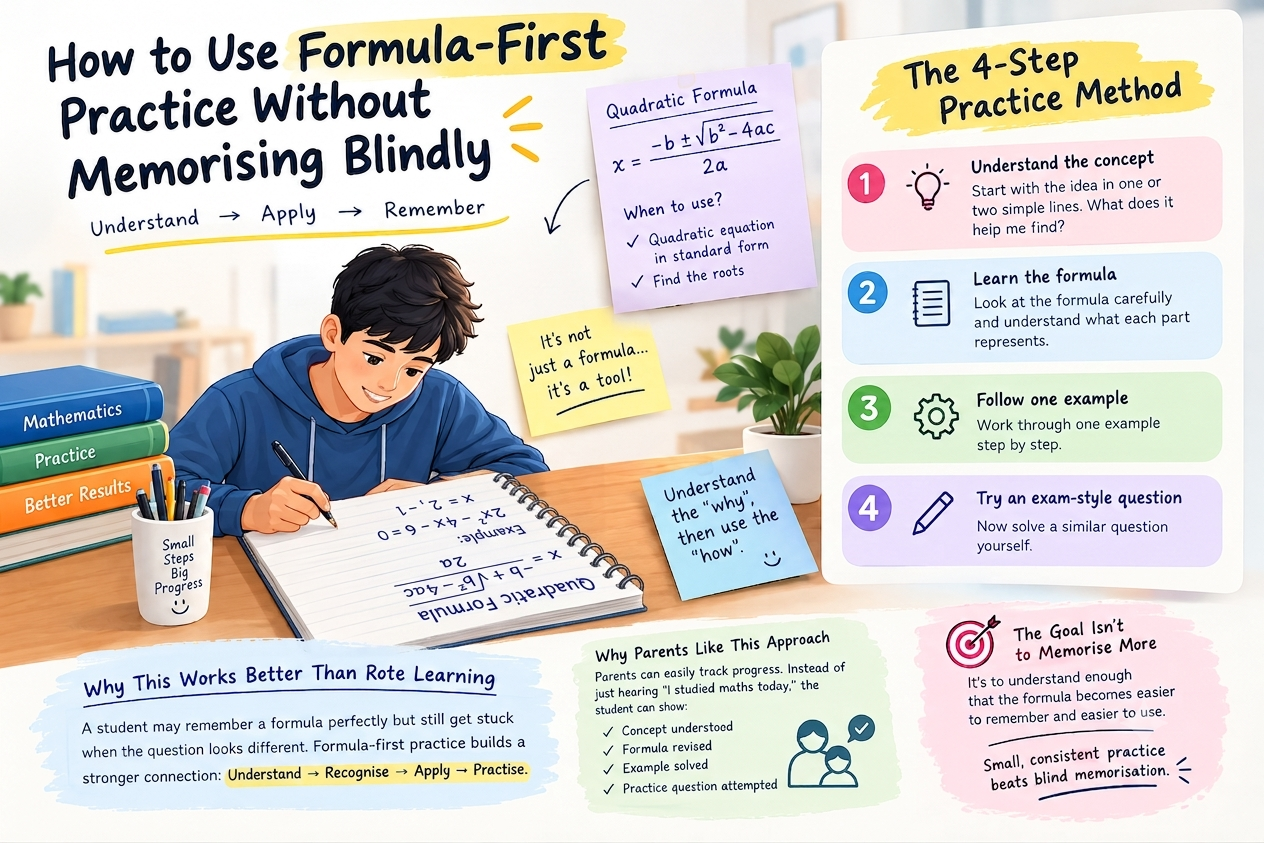
For example, the quadratic formula is not just something to memorise. It is a useful method for finding the roots of a quadratic equation when it is written in standard form.
A Simple 4-Step Practice Method
- Understand the concept: start with the idea in one or two simple lines. Ask what the formula helps you find.
- Learn the formula: look at the formula carefully and understand what each part represents.
- Follow one example: work through one example step by step so the formula connects with an actual question.
- Try an exam-style question: solve a similar question yourself so understanding turns into practice.
Why This Works Better Than Rote Learning
A student may remember a formula perfectly but still get stuck when the question looks different.
Formula-first practice builds a stronger connection: Understand, Recognise, Apply, Practise.
With regular practice, students gradually become better at recognising which formula they need and when to use it.
Why Parents Like This Approach
Parents can see exactly what the student has worked on.
Instead of simply saying, "I studied maths today," the student can show real progress.
That makes progress easier to track and gives both the student and parent a clearer picture of what is actually improving.
- Concept understood
- Formula revised
- Example solved
- Practice question attempted
The Goal Is Not To Memorise More
The goal is to understand enough that the formula becomes easier to remember and easier to use.
Start with one formula. Understand it. Solve one example. Then practise.
Small, consistent practice beats blindly memorising a whole page of formulas.